Blog
Why Anti-Corruption in Fragile Settings Is an Even Bigger Imperative
by Professor Pallavi Roy Evidence-based and solution-focused research on corruption in fragile contexts is central to strengthening the shift from fragility to resilience. In such settings, where shocks are more frequent and coping capacities weaker, the imperative to act against corruption needs ...
Political Corruption, Material Interests and Social Norms
By Cathy Shutt Last year the SOAS ACE programme convened a series of multi-disciplinary conversations on what political corruption might mean for accountability and for anti-corruption researchers and practitioners. One of the most interesting discussions was around social norms, which ...
Context matters in scaling for fragile settings, but how? A case study for setting up a mini grid for SMEs in Nigeria.
This blog post is based on a presentation delivered by Dr Pallavi Roy on “Political economies of scaling fragile contexts” for the annual forum of Communities of Practice for Scaling. Scaling is the process of successfully expanding, adapting, and implementing ...
SOAS-ACE June 2023 newsletter
We are excited to announce a new phase of the SOAS Anti-Corruption Evidence (ACE) research programme funded by the UK’s Foreign, Commonwealth and Development Office (FCDO) which will now run until 2027. SOAS ACE will build on the insights and ...
SOAS-ACE Newsletter March 2023: new anticorruption toolkit, online course and papers
A New Approach to Anti-Corruption – When Rule-Breakers rule This toolkit provides a step by step guide to analysing corruption problems and developing realistic and effective anti-corruption strategies in contexts where the rule of law is weak. Over the past 5 years, ...
29 March 2022 Event – Making anti-corruption real: how to stop wasting money and start making progress
Join us for our SOAS-ACE end-of-programme event! Corruption is likely to be extensive, persistent and damaging in places where the rule of law is weak, or where the context for rule enforcement is adverse. Most low and middle income countries are ...
SOAS-ACE March 2022 newsletter
Upcoming event: Making anti-corruption real: how to stop wasting money and start making progress Tuesday, 29 March 2022, 9:30am - 12:30pm BST (GMT+1) In early 2022, Transparency International reported that ‘corruption levels remain at a standstill worldwide, with 86% of countries making ...
SOAS-ACE December 2021 newsletter
2021 has been a busy year for the SOAS-ACE programme as the SOAS Team and our partners complete our research projects and work with stakeholders in different sectors and countries around the world to explore feasible and effective anti-corruption strategies. ...
SOAS-ACE September 2021 newsletter
The SOAS-ACE programme has published a number of fascinating new working papers, briefings and journal articles over the last few months (see listing below). We've been running a number of events and have an exciting event coming up on 22 September ...
Nigeria’s ‘miracle examination centres’ undermine education: how to stop the rot
This blog was written by a team of researchers of the University of Nigeria, Nsukka, partner of the SOAS Anti-Corruption Evidence Consortium, and Dr Pallavi Roy of SOAS-ACE. It was originally published on The Conversation on 2 February 2022. It is republished ...
What opportunities are there for reducing corruption in climate finance and the energy transition?
As the dust settles following COP26 in Glasgow and the world reflects on what was, and was not achieved, it is clear that climate finance is going to be a critical factor in whether countries around the globe are able ...
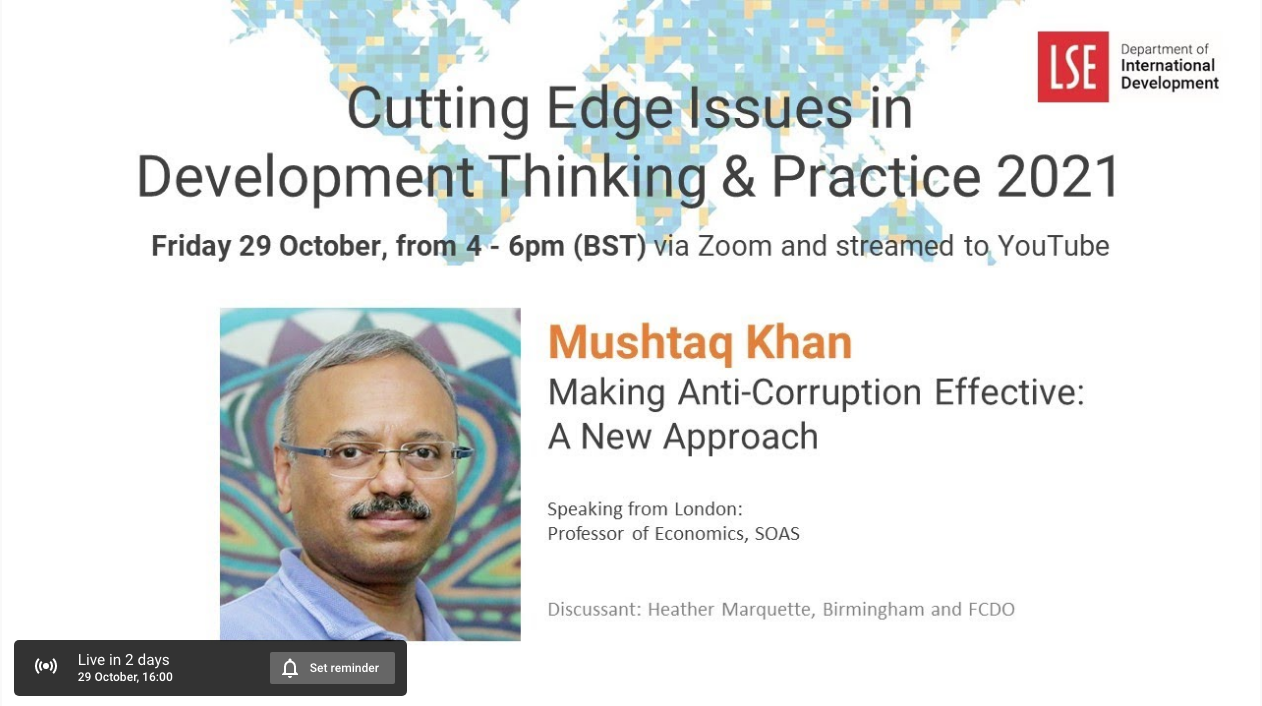
Cutting Edge Issues in Development – Making Anti-Corruption Effective: A New Approach
This blog was written by Hayoung Lee, MSc student of Development Studies at LSE. It was originally published on LSE Department of International Development on 3 November 2021. It is republished here under a Creative Commons licence. On Friday 29 ...